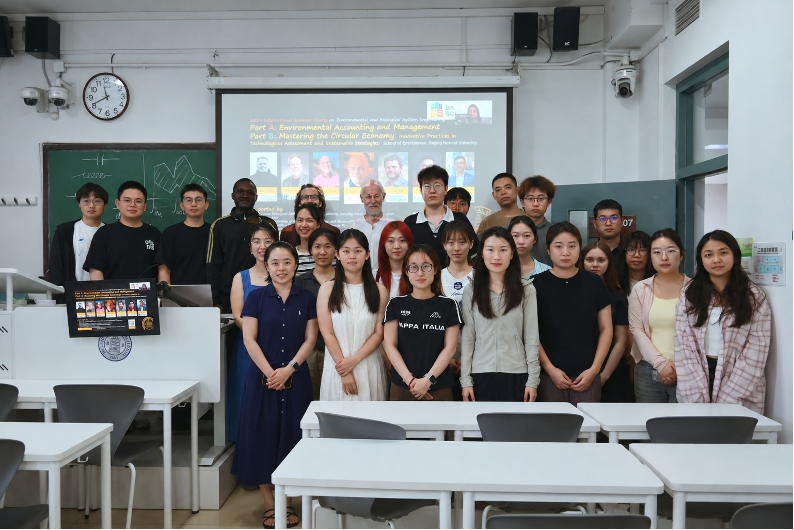
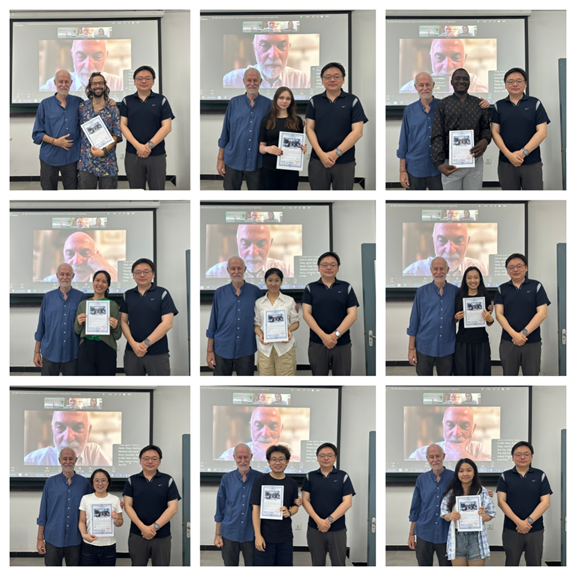
On July 16, 2026, the "International Summer Course on Environmental and Ecological System Engineering" successfully concluded. Hosted by the School of Environment at Beijing Normal University, the four-day intensive program featured 20 comprehensive sessions. Over 50 students engaged in deep, interactive dialogues with top-tier scholars, gaining profound insights into the fields of environmental accounting and systems thinking. The course brought together leading authorities from the international emergy academic community:
Professor Mark Brown: Initiated the discourse with the fundamental question of "why organized systems exist". He systematically taught emergy principles, energy quality hierarchies, global emergy baselines, and multi-scale emergy accounting methods, presenting a panoramic view of emergy analysis from Earth systems to national economies.
Professor Francesco Gonella: Focused on systems thinking and Energy Systems Language (ESL). Rooted in the laws of thermodynamics, he guided students to master stock-flow-process diagrams and feedback analysis. He transformed abstract systems thinking into actionable analytical tools through exercises ranging from the iceberg model and greenhouse effect diagrams to bioelectricity system evaluations.
Professor Sergio Ulgiati: Focused on the integrated application of Life Cycle Assessment (LCA) and emergy evaluation. Using real-world cases such as agrochemicals, electric vehicles, and transportation systems, he detailed the synergistic methods of utilizing LCA databases and emergy indicators for sustainability assessments.
Professor Gengyuan Liu: Hosted the entire course, guiding the discussions to focus on core issues and ensuring the highly efficient progression of the program.I. Systems Thinking and Energy Systems Language: From Conceptual Frameworks to Analytical Tools
The course started with the fundamental question of "why systems thinking is needed," building a complete cognitive chain from philosophical speculation to quantitative tools. Professor Gonella quoted Albert Einstein, noting that problems cannot be solved with the same thinking used to create them, highlighting that modern challenges like climate change and biodiversity loss are systemic issues requiring us to transcend linear causal thinking. He utilized the iceberg model to demonstrate that true intervention must penetrate system structures and mental models. Furthermore, he used greenhouse effect diagrams to visually explain the systemic mechanism of how greenhouse gases cause temperature rises by narrowing heat outflows.
In the Energy Systems Language (ESL) segment, the course systematically explained the three basic elements: stocks, flows, and processes, along with core concepts like system boundaries and feedback loops. Students translated abstract concepts into hand-drawn system diagrams by identifying reinforcing and balancing feedback examples in daily life. Through progressive training—from feedback loop diagramming exercises to the emergy evaluation of bioelectricity systems, and from thermodynamic open systems to system archetypes—students developed the core capability to describe and analyze complex systems bridging nature and society using a unified energy language.
II. Multi-Scale Emergy Evaluation: From Earth Systems to Policy Applications
Professor Brown constructed an emergy analysis framework ranging from the micro to the macro level:
- Micro-level: Students mastered the calculation methods for the available energy of sunlight, wind, rain, fuels, and minerals.
- Meso-level: Using a bioelectricity system as the subject, students completed a full evaluation process from drawing system diagrams to summarizing emergy indicators.
- Macro-level: The course simulated national-scale emergy metabolism networks. Students developed an understanding of money's role as an emergy backflow, emergy balances in international trade, and national sustainability indicators.
The curriculum covered the systematic application of emergy methods across various scales, exploring the relationship between emergy and economics, ecosystem evaluations, environmental impact assessments, and the comparison of alternative solutions.
Professor Ulgiati deeply integrated Life Cycle Assessment (LCA) with emergy evaluation. Starting with the basic principles of LCA and environmental inventory analysis, the course transitioned into the Emergy-LCA integration method. Demonstrating how LCA databases provide inputs for emergy evaluation, he used agrochemical and electric vehicle cases to show how the synergy of both methods offers a more comprehensive sustainability assessment. In the policy application segment, students saw how emergy indicators provide quantitative support for sustainable development and resilience policies across fields like transportation systems, circular economies, and trade. Additionally, Professor Francesco used the bioelectricity system to guide students through the entire evaluation process, demonstrating how different scale analyses profoundly impact sustainability conclusions via boundary extension exercises.
III. Emergence of New Idea in an International Classroom
By combining theoretical lectures with practical case studies, this course enabled international students to deeply master the core theories and quantitative tools of environmental accounting and systems thinking. During the sessions, students engaged in multiple discussions centered on core topics. In the feedback diagramming exercises, students discovered feedback examples in daily life, climate systems, and engineering technologies, translating reinforcing and balancing feedbacks into ESL diagrams. Professors selected typical assignments for on-site discussion, stimulating deep reflections on system boundaries and feedback types. During the emergy evaluation case study on the "sustainability evaluation of bioelectricity systems," students explored how expanding system boundaries alters emergy indicators and sustainability conclusions. These divergences perfectly illustrated the course's emphasis on the interconnected logic of "scale-boundary-narrative". In the final comprehensive synthesis workshop, students integrated their four days of learning through discussions on ecosystems, cities, boundaries, and sustainability.
No Comments