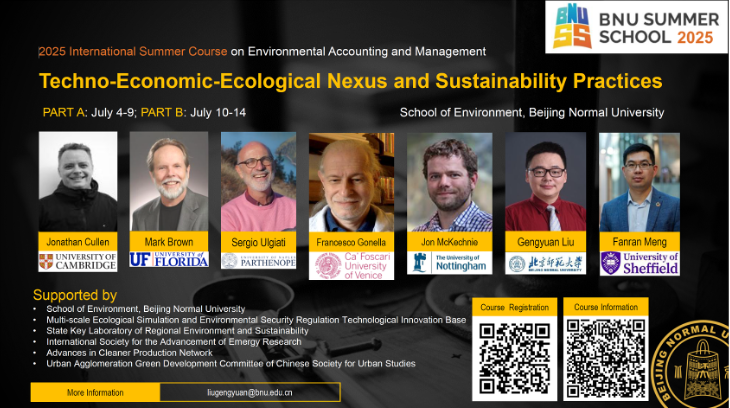
Are you a postgraduate or undergraduate student passionate about environmental and ecological engineering? Beijing Normal University (BNU) invites you to their 2025 Summer School on Environmental and Ecological Systems Engineering, offering two intensive courses designed to equip you with cutting-edge knowledge and practical skills.
Course Topics:
This summer school offers two distinct, yet complementary, courses:
- PART A: Mastering the Circular Economy: Innovative Practices in Technological Assessment and Sustainable Systems (July 5-9, 2025)
- PART B: Redefining the Green Future: Global Perspectives on Environmental Accounting and Systems Thinking (July 10-14, 2025)
You'll gain invaluable insights from leading international experts in the field.
What You'll Learn:
PART A: Mastering the Circular Economy
This course will dive deep into Techno-Economic Analysis (TEA) and Life Cycle Assessment (LCA), crucial tools for evaluating sustainable systems.
July 5, 2025 AM:
- Technical-Economic Analysis (TEA) Overview: Introduction to TEA and its role in research and commercialization.
- TEA Core Concepts: Key concepts and components of TEA studies.
- TEA Applications: Applications in chemical engineering and energy systems.
- Cost Estimation: Estimating production costs.
July 5, 2025 PM:
- Renewable Energy Technology Example: Worked example of renewable energy technology, towards calculating levelized cost of energy.
July 6, 2025 AM:
- Introduction to Financial Evaluation Methods: Financial evaluation methods (e.g., NPV, IRR, pay-back period).
- Introduction to Sensitivity Analysis Methods: Sensitivity analysis: single parameter; scenario analysis; multiple parameter (e.g., Monte Carlo).
July 6, 2025 PM:
- Renewable Energy Techno-Economic Assessment Example: Worked example assessing financial performance of renewable energy technology, and incorporation of single-parameter sensitivity analysis and scenario analysis.
July 7, 2025 AM:
- Life Cycle Thinking and Methods Overview: Overview of life cycle thinking and LCA methodology.
- Life Cycle Assessment Research Paradigms: Research applications of LCA—case study examples from low TRL technologies through to policy impact analysis of available technologies.
- LCA-TEA Collaborative Modeling: Integrating LCA and TEA methods to quantify trade-offs in cost and climate objectives.
July 7, 2025 PM:
- Empirical Study of Renewable Energy Technology Environmental Impact: Worked example assessing environmental impacts of renewable energy technology.
- LCA-TEA Collaborative Modeling Example: Worked example integrating LCA and TEA, and scenario analysis to quantify levelized cost of carbon savings.
July 8, 2025 AM:
- Sustainable Materials - Resource Efficiency Analysis: Sustainable materials - resource efficiency.
- Sustainable Industry - Exergy Analysis: Sustainable industry - exergy analysis.
July 8, 2025 PM:
- Resource Flow Visualization: Sankey diagrams.
- Exergy Analysis Modeling: Conducting exergy analysis.
July 9, 2025 AM:
- Circular Economy Innovation Evaluation: Circular economy (new metrics).
July 9, 2025 PM:
- Circularity Engineering Practice: Applying circularity.
- Global Energy Systems Modeling: Global energy systems modeling, e.g. global calculator, or Osmoesys.
PART B: Redefining the Green Future
This course focuses on Environmental Accounting and Systems Thinking, offering a global perspective on building a sustainable future.
July 10, 2025 AM:
- Systems Thinking and Diagramming Feedback Analysis: A short summary of Systems Thinking and diagramming; the importance of feedbacks.
- Emergy Accounting: The emergy accounting of an energy plant for its sustainability assessment.
- Sustainability Concept Analysis: Case study: a biogas power plant.
- System Boundary Extension in Emergy Accounting: The role of boundary extension in the emergy accounting.
July 10, 2025 PM:
- Systems Thinking Discussion and Illustration: Discussion of systems thinking, why think systemically? Drawing diagrams.
- Emergy Theory Principles and Concepts: Discussion of emergy principles and concepts and how they relate to everyday life. Examples of laws of thermodynamics, maximum power, hierarchy, Maximum Power Principle.
- Geosphere Emergy Baseline Calculation: Calculation of renewable emergy sources from the Geosphere Emergy Baseline.
July 11, 2025 AM:
- Life Cycle Assessment and Emergy Accounting: Quick description of LCA and its use for calculation of UEVs. Examples: UEVs of chemicals used in agriculture.
- Pulp and Paper System Ecological Optimization: Paper making and recycling. Integrated use of LCA and Emergy for high quality paper making and assessment.
- Emergy Analysis for Circular Economy Policy Design: Emergy for Circular Economy policy-making.
- Urban Waste Management Emergy Modeling: Urban waste management and wastewater, and waste management policies.
July 11, 2025 PM:
- Emergy Algebraic Rule System: Discussion of Emergy Algebra, issue of double counting. Static and dynamic emergy accounting.
- Static Emergy Analysis Table Construction: Example emergy accounting table: Static accounting.
- Dynamic Emergy Analysis Table Construction: Example of dynamic accounting: EXCEL solver.
July 12, 2025 AM:
- Multi-modal Transportation System Emergy Assessment: Transportation patterns (cars, buses, trains and high speed trains, flights) and mobility policies.
- Diverse Power Generation System Emergy Assessment: Electricity generation from different sources.
- Urban-Rural System Emergy Assessment: Emergy assessment of rural and urban environment.
- Electronic Waste Recycling Emergy Assessment: Emergy evaluation of electronic waste recovery: costs and benefits.
July 12, 2025 PM:
- Emergy-Economy-Money Relationship Discussion: Discussion of the relations between emergy, economy, and money.
- NEAD Database Usage: Using the NEAD.
- Emergy and Urban Systems Relationship Discussion: Discussion of the relations between emergy and urban systems.
July 13, 2025 AM:
- Quick Definition of "Value": Money, energy, emergy.
- Practical Emergy Evaluation Cases: Practical examples of emergy evaluations to understand values and support choices (e.g. trade, agriculture, energy, recycling, water).
- Bioelectricity Production System Emergy Accounting: Emergy accounting of a bioelectricity production site.
- Agriculture-Breeding-Conversion: The role of subsystems in the emergy systemic description.
July 13, 2025 PM:
- Ecosystem Core Concepts and Limiting Factors Principle Discussion: Discussion of the concept of “ecosystem” … the difference between natural capital and ecosystem services. Why is limiting factors principle so important? Species and information.
- Estuarine System Emergy Calculation and Mapping: Computing and graphing emergy signature of estuarine system.
- Estuarine System Emergy Assessment: Emergy evaluation of estuarine impacts and losses.
July 14, 2025 AM:
- Bioelectricity Production Sustainability Assessment: Sustainability assessment of bioelectricity production through emergy indicators.
- System Sustainability at Different Scales and Boundary Solutions: How different scales and boundaries address different narratives for the system sustainability.
July 14, 2025 PM:
Model Simulation: Examples using EXCEL.
Environmental Impact Emergy Assessment Discussion: Discussion of concept of environmental impact…assessing environmental impacts.
Emergy Evaluation of Alternatives and Net Emergy Calculation: Discussion of emergy evaluation of alternatives. Computing Net Emergy.
Meet Your Esteemed Teaching Team:
You'll learn from a distinguished international faculty:
PART A:

Prof. Jonathan Cullen (University of Cambridge)
A leading expert in sustainable engineering, focusing on efficiency in energy-intensive industries and resource constraints for renewable technologies.

Prof. Jon McKechnie. (University of Nottingham)
Specializes in techno-economic analysis (TEA) and life cycle assessment (LCA) for energy systems.

Dr. Fanran Meng (University of Sheffield)
Focuses on resource efficiency and sustainable engineering systems, driving industrial decarbonization.
PART B:

Prof. Mark Brown (University of Florida)
Emeritus Professor and Director of the Wetlands and Environmental Policy Research Center, a pioneer in integrating energy, ecology, and economy.

Prof. Sergio Ulgiati (University of Naples Parthenope, Italy)
An expert in sustainable systems analysis and ecological economics, integrating emergy analysis with LCA.

Prof. Francesco Gonella (Ca’ Foscari University of Venice, Italy)
His research interests include environmental physics, environment-health nexus, and systems thinking.

Prof. Gengyuan Liu (Beijing Normal University)
His research focuses on urban metabolism, environmental nexus, and value realization mechanisms for ecological products.
Who Should Attend?
This program is primarily designed for current postgraduate students in environmental and ecological engineering or related disciplines from international universities and research institutions. There are also limited enrollment opportunities for undergraduates.
Upon successful completion of the program, participants will receive a course completion certificate. BNU students have the added benefit of being able to apply for course credits by submitting their student ID number after completing the course.
How to Register
Interested applicants are kindly requested to complete their registration by June 20, 2025. You can register by visiting the designated link - HERE.
If you have any questions, please do not hesitate to email zhengxy2324@163.com.
Join us!
We enthusiastically welcome students from all universities and research institutions across the globe to take part!
Supported By
This summer school is proudly supported by:
- Urban Agglomeration Green Development Committee of Chinese Society for Urban Studies
- School of Environment, Beijing Normal University
- Multi-scale Ecological Simulation and Environmental Security Regulation Technological Innovation Base
- State Key Laboratory of Regional Environment and Sustainability
- International Society for Advancement Emergy Research
- Advances in Cleaner Production Network
No Comments